From Idea to Impact: The Journey of Creating and Launching a Higher Education Microcredential
As interest in microcredentials continues to grow across higher education, institutions are increasingly asking a practical question: How do we actually create and launch a high quality microcredential?
The answer is both simpler and more complex than many people realize. While the specifics vary across institutions, most successful microcredentials follow a similar developmental journey: from identifying an opportunity to ultimately awarding learners with a credential that is meaningful, portable, and valued by employers.
Having worked with institutions, systems, and workforce partners on microcredential initiatives, I've found it helpful to think about microcredential development not as a single project, but as an ecosystem process involving academic leaders, faculty, employers/industry partners, instructional designers, marketers, technologists, navigators, and credentialing specialists.
Below is a broad roadmap of the key phases involved in developing and launching a non-credit microcredential or microcredential pathway. Please note that the work that was done to lead up to this blog post was done collaboratively with Sasha Flores.
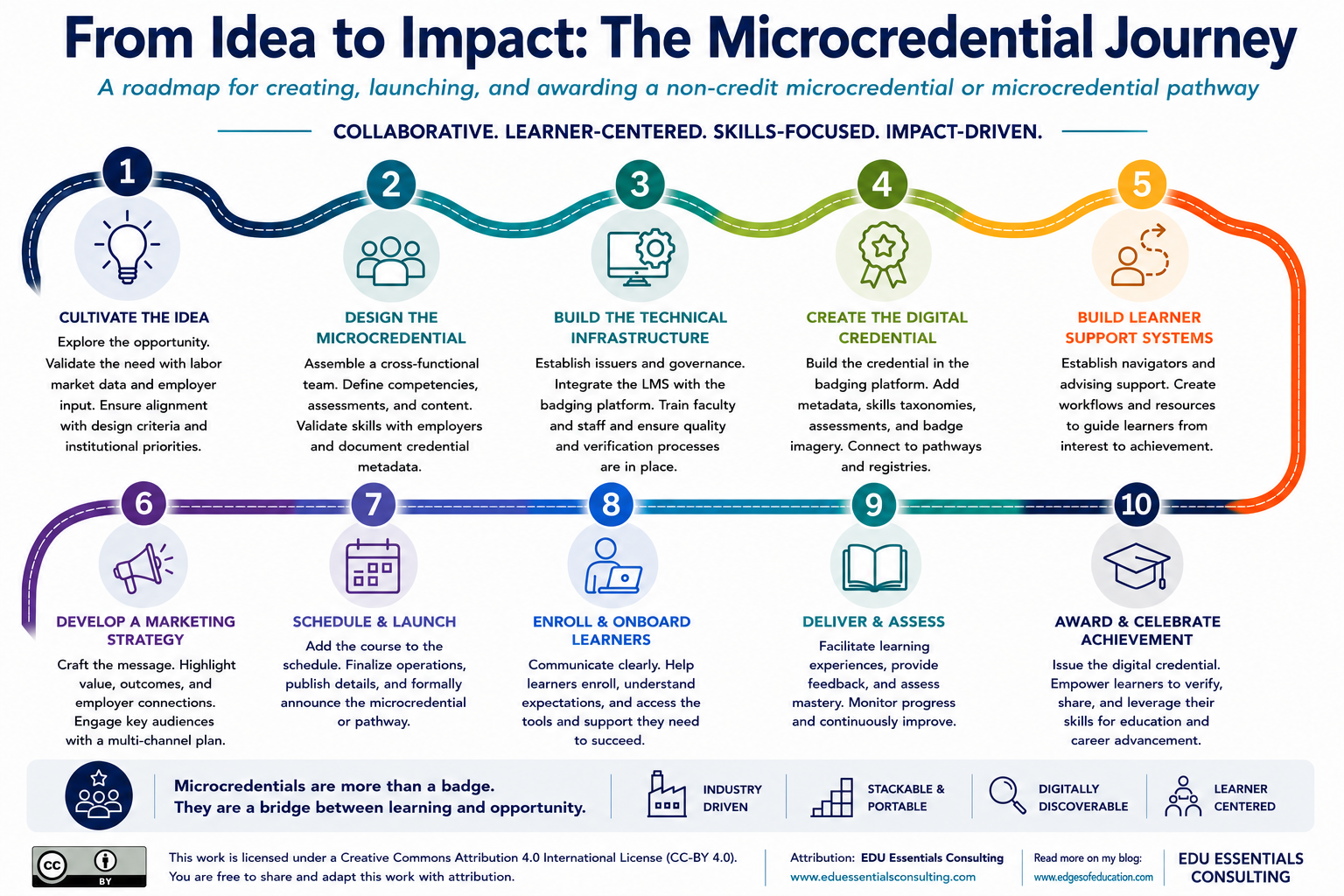
Infographic showing a 10-step roadmap for creating and launching a higher education microcredential, from idea development and design through learner support, delivery, and awarding a digital credential.
Phase 1: Cultivating the Idea
Every microcredential begins with an idea.
Sometimes that idea originates with faculty who identify an emerging skill need. Other times it comes from employers struggling to fill positions, workforce agencies seeking talent pipelines, or institutional leaders responding to strategic priorities.
Before investing significant resources, institutions should evaluate whether the concept aligns with established microcredential design principles. Strong microcredentials typically:
Stack with other credentials and support educational mobility
Align with regional labor market demand and wage outcomes
Are validated by employers and industry partners
Can be completed within a relatively short timeframe
Offer flexible delivery options
Are affordable and accessible
Can be digitally discovered and shared
Include durable and transferable skills (Education Design Lab, 2023)
This phase often involves obtaining institutional endorsement, conducting preliminary market analysis, identifying potential internal and external partners, and determining whether the proposed credential addresses a genuine workforce need.
Perhaps the most important question at this stage is not, "Can we build this?" but rather, "Should we build this?"
Phase 2: Designing the Microcredential
Once a concept has been validated, the real design work begins.
Developing a high quality microcredential requires assembling a cross functional team that may include faculty subject matter experts, instructional designers, workforce partners, curriculum specialists, and assessment experts.
During this phase, teams typically:
Define learning outcomes and competencies
Identify applicable skills frameworks and taxonomies
Develop assessments that demonstrate mastery
Create instructional content and learning experiences
Validate skills with employers
Determine stackability and pathway relationships
Document credential metadata
This stage is where institutions move beyond content creation and begin designing for trust, transparency, and transferability.
Questions of credential ownership and branding also emerge. Institutions may create credentials independently or partner with external organizations, industry associations, or employers. Each approach carries different considerations related to branding, governance, and credential recognition.
Phase 3: Building the Technical Infrastructure
Even the most thoughtfully designed microcredential cannot succeed without the underlying technical infrastructure needed to issue, verify, and share credentials.
This phase typically involves:
Determining credential issuers and governance structures
Configuring integrations between learning management systems and digital badging platforms
Training faculty and staff on credential issuance processes
Establishing workflows for learner completion and verification
Defining quality assurance procedures
The technology should ultimately become invisible to learners. However, significant planning and coordination are often required behind the scenes to create a seamless experience.
Phase 4: Creating the Digital Credential
Once the infrastructure is established, institutions can formally create the microcredential within their credentialing platform.
This process involves documenting the information that gives a digital credential its value and credibility, including:
Credential descriptions and outcomes
Competencies and skills demonstrated
Skills frameworks and taxonomies used
Assessment evidence
Issuing authority
Badge imagery and branding
Pathway relationships and stackability information
Many institutions are also beginning to register credentials within broader credential registries and discovery platforms to increase visibility, portability, and learner mobility.
A digital badge is more than an image. It is a container of evidence, context, and trust.
Phase 5: Building Learner Support Systems
One lesson institutions quickly learn is that creating a microcredential is only part of the challenge. Supporting learners through the experience is equally important.
Many institutions establish dedicated navigators or support personnel who help learners:
Understand credential options
Navigate enrollment processes
Identify pathway opportunities
Connect credentials to educational and career goals
Receive ongoing communication and support
This phase often involves developing communication workflows, automated outreach, advising resources, and learner support materials.
Microcredentials may be smaller than degrees, but learners still require guidance to successfully navigate them.
Phase 6: Developing a Marketing Strategy
A common mistake institutions make is assuming that "if we build it, they will come."
Successful microcredentials require intentional marketing strategies that engage multiple audiences, including:
Current students
Prospective students
Adult learners
People working in the industry
Employers
Workforce agencies
Community organizations
Internal stakeholders
Effective marketing plans clearly communicate:
The value proposition
Career outcomes
Skills gained
Employer validation
Cost and time commitment
Pathway opportunities
Marketing is not simply promotion; it is translation. Institutions must communicate educational value in ways that resonate with learners and employers alike.
Phase 7: Scheduling and Launch
As the credential moves toward implementation, institutions transition from design to operations.
Key activities include:
Scheduling courses and offerings
Finalizing operational workflows
Publishing credential information
Launching marketing campaigns
Announcing the credential internally and externally
At this point, months of planning and collaboration become visible to prospective learners.
Phase 8: Enrollment and Learner Onboarding
Once learners enroll, institutions must ensure they understand:
Program expectations
Learning technologies
Support resources
Assessment requirements
Credential awarding processes
Opportunities for continued learning
A positive onboarding experience can significantly improve learner persistence and completion.
Phase 9: Delivery and Assessment
The microcredential is now live.
Faculty facilitate learning experiences, assess learner mastery, provide feedback, and support learners through completion. Throughout delivery, institutions should gather data on learner engagement, completion rates, satisfaction, and outcomes.
This information becomes critical for continuous improvement.
Phase 10: Awarding the Credential
The final phase is also the beginning of the next journey.
Upon successful completion, learners receive a digital credential that recognizes their achievement and enables them to communicate their skills to employers, educational institutions, and professional networks.
Institutions should ensure that awarded credentials are:
Easily shareable
Verifiable
Portable
Rich in metadata
Connected to broader educational and workforce pathways
The awarding of a microcredential is not simply the end of a course. It is the creation of a trusted signal of learning.
Final Thoughts
While every institution's process will differ, developing a successful microcredential requires more than creating a short course and issuing a digital badge. It requires strategic alignment, employer engagement, instructional design expertise, technical infrastructure, learner support systems, and ongoing evaluation.
Perhaps the most important takeaway is this: microcredentials are not products. They are ecosystems.
The institutions that succeed in this work are those that recognize that creating meaningful, trusted, and transferable credentials requires collaboration across academic affairs, workforce development, student services, technology, marketing, and industry partners.
The journey from idea to credential may be complex, but when done well, the result is a powerful new way to connect learning with opportunity.
References:
Education Design Lab, (2023). Micro-Pathways, Macro Impact How the micro-pathways design process transforms community colleges. Retrieved from https://eddesignlab.org/wp-content/uploads/2025/08/Micro-Pathways-Macro-Impact-Education-Design-Lab-July-2025.pdf
